1. Introduction
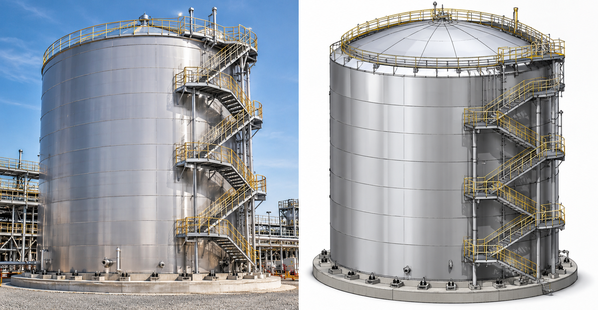
This industrial vertical storage tank is a 38'-0" O.D. × 50'-0" high vessel engineered for vinyl acetate (SG 0.93) storage, featuring a net operational capacity of 260,209.5 US gallons.
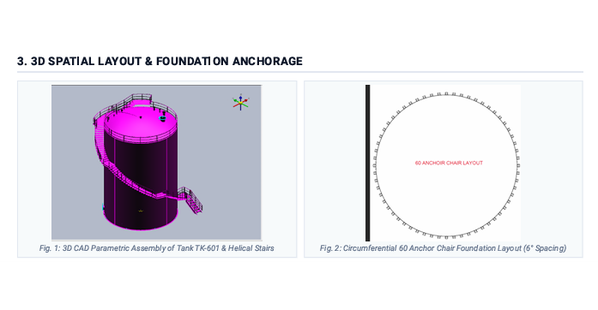
The project scope covered structural modeling, mechanical coordination, and drafting for an API-620 compliant vessel with a multi-landing helical stairway. The goal was to resolve spatial interferences between the civil foundation, a dense ring of anchor chairs, nozzle attachments, and a self-supported dome roof, starting from preliminary general arrangement markups.
Summary
Six design problems were resolved with four targeted moves: an offset stair support, a lowered first platform, modular isolated walkways, and a dome roof with full-penetration welds and a braced dip pipe. The result is an API-620 compliant package that needed no site rework.
Tank Technical Specifications
| Item | Detail |
|---|---|
| Material | ASTM A240 Type 304/304L stainless steel |
| Design codes | API-620, ASCE 7-10, ASME V |
| Pressure | 15 psig internal, −0.15 psi vacuum |
| Design temperature | 250°F (MDMT −20°F) |
| Wind / snow | 120 mph / 25 psf ground snow |
| Foundation | Concrete slab, 60 anchor chairs at 6° spacing |
| Nozzles and manways | 21 |
2. Challenges
Six engineering problems had to be solved before design certification:
1. Anchor chairs vs. stair supports: The civil spec required 60 anchor chairs every 6°. Standard stair down-legs and knee-brace footings clashed with the chair gusset plates and the ringwall curb, which would have put unverified eccentric bending into the shell.
2. Stair geometry and Platform #1 height: Early geometry gave irregular risers and non-compliant headroom under the lower shell nozzles.
3. Shipping size: Curved walkways around a 38'-0" vessel exceed standard shipping envelopes.
4. Column-free dome roof: The roof had to span 38'-0" under 15 psig, −0.15 psi vacuum, 25 psf snow and a 500 lb point load without buckling or membrane overstress.
5. Dip pipe thrust and vibration: Inflow at nozzle A2 causes vibration and vortexing on the submerged downcomer, risking fatigue failure.
6. Dissimilar metals: Galvanized carbon steel walkways bolted directly to the 304L shell risk galvanic corrosion at the contact points and stress from differing thermal expansion.
3. Approach
Four targeted moves resolved all six problems at the design stage:
1. Offset the starter knee support (Challenge 1): The support was shifted 12" outward onto an independent baseplate, clear of the chair gussets and ringwall curb, so no eccentric bending reaches the shell.
2. Lower Platform #1 by 16" (Challenge 2): Regular stair risers and compliant headroom under the lower shell nozzles.
3. Splice the walkways into modular arcs with stainless isolation clips (Challenges 3 and 6): The arcs fit standard shipping envelopes. The clips keep galvanized steel off the 304L shell and allow for differential thermal movement.
4. Detail the dome roof and dip pipe (Challenges 4 and 5): Full-penetration welds let the dome carry pressure, vacuum, snow and point loads without columns. Bracing on the dip pipe resists inflow thrust and vibration at nozzle A2.
4. Conclusion
The project delivered a certified 3D model and approved general arrangement drawings for the 38'-0" O.D. × 50'-0" stainless steel vessel, with all six design problems resolved before fabrication.
The clash-free package eliminated site rework, is API-620 compliant, and gives operators safe, ergonomic access to every landing and the roof platform under 120 mph wind loading.