1. Introduction
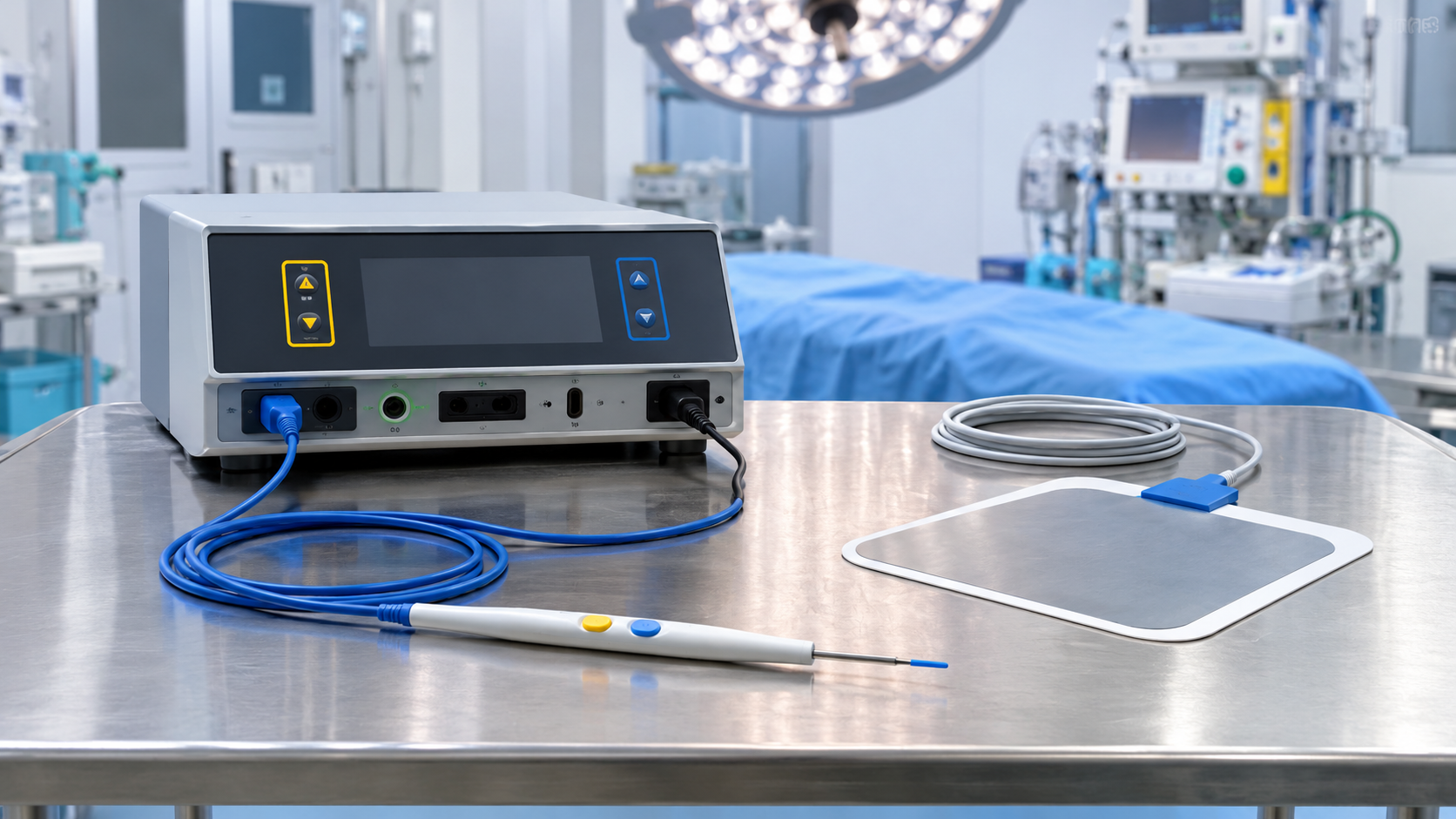
This medical-grade Electrosurgical Unit (ESU) is a high-frequency surgical device designed for use in Operation Theaters. It performs precision cutting, coagulation and vessel ligation using high-frequency electrical currents, with minimal blood loss and full surgical safety compliance.
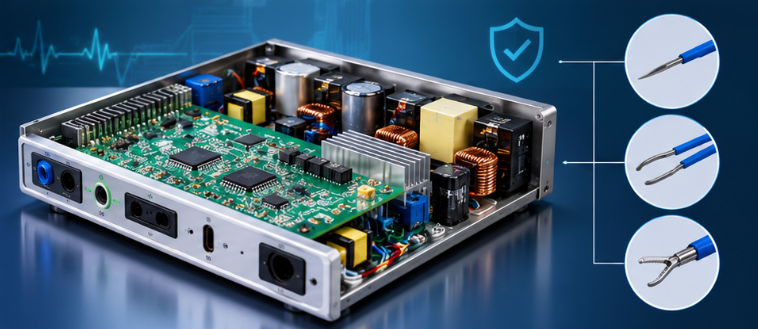
The project covered the electronics design of the complete unit: high-frequency signal generation, power electronics, an embedded controller, safety monitoring and a touchscreen interface. The unit supports monopolar, bipolar and ligation probes across general surgery, orthopaedics, ENT, vascular surgery, gynaecology, dermatology and colorectal surgery.
Summary
A production-ready, multi-mode electrosurgical unit was designed to cut, coagulate, blend and ligate tissue using three probe types. Safety interlocks and a touchscreen interface keep surgery precise and controlled. The result is a unit that meets medical device safety standards and reduces the number of devices needed per operating room.
ESU Technical Overview
| Item | Detail |
|---|---|
| Device | Medical-grade high-frequency electrosurgical unit |
| Use | Operation Theaters |
| Output modes | Cut, Coagulate, Blend and Ligation |
| Probe types | Monopolar, Bipolar and Ligation |
| Safety | Patient return electrode monitoring and arc detection interlocks |
| User interface | Touchscreen for mode selection, power level and alarm status |
| Technologies | Power electronics, HF signal generation, embedded MCU, touchscreen GUI, safety monitoring, medical-grade PCB |
Probe Types
| Probe | How it works | Typical use |
|---|---|---|
| Monopolar | Single active electrode with a dispersive return pad | Cutting and fulguration in open surgery |
| Bipolar | Both electrodes at the tip, with minimal current spread | Precise coagulation in delicate tissue |
| Ligation | Seals and divides simultaneously | Laparoscopic and colorectal vessel sealing |
2. Challenges
Five engineering problems had to be solved to deliver a safe, production-ready surgical device:
1. Precision tissue interaction: The unit had to generate high-frequency electrical current accurately enough to cut and coagulate tissue with minimal blood loss.
2. Multiple surgical modes: One device had to deliver Cut, Coagulate, Blend and Ligation outputs for very different procedures, from soft tissue incision to vessel sealing.
3. Three probe types: Monopolar, bipolar and ligation probes each behave differently, and the unit had to support all of them.
4. Patient and surgical safety: High-frequency current in an operating room requires continuous monitoring of the patient return electrode and detection of arcing.
5. Clear, fast operation: Surgical staff needed to change mode and power level and see alarm status quickly during a procedure.
3. Approach
Four targeted moves resolved all five problems at the design stage:
1. High-frequency power and signal design (Challenge 1): Power electronics and HF signal generation were designed for precise control of the current delivered to tissue.
2. Multi-mode output with an embedded controller (Challenges 2 and 3): An embedded MCU manages Cut, Coagulate, Blend and Ligation modes and supports monopolar, bipolar and ligation probes from a single unit.
3. Built-in safety interlocks (Challenge 4): Patient return electrode monitoring and arc detection were built into the design as safety monitoring, on a medical-grade PCB.
4. Touchscreen interface (Challenge 5): A touchscreen GUI lets staff select the mode, set the power level and see alarm status in one place.
4. Conclusion
The project delivered a production-ready Electrosurgical Unit that meets medical device safety standards, with all five design problems resolved at the design stage.
Its multi-mode capability reduces the number of devices needed in each operating room, and precise high-frequency control supports minimally invasive surgery with reduced blood loss.