This project involved the structural and mechanical design of a skid-mounted RO-DI Polish System for a North American company. The objective was to engineer a compact, fully integrated packaged water treatment system capable of delivering ultra-pure water within strict spatial and material constraints. High-purity water systems are needed in advanced energy applications to prevent contamination, scaling, and interference in sensitive operational environments. The skid takes pre-treated water through final polishing stages to achieve maximum purity.
Project Scope: A single transportable modular skid integrating DI tanks, multistage pumping, sub-micron cartridge filtration, UV disinfection, control valves, and inline instrumentation, built to industry-standard piping dimensions, pressure ratings, and structural load requirements.
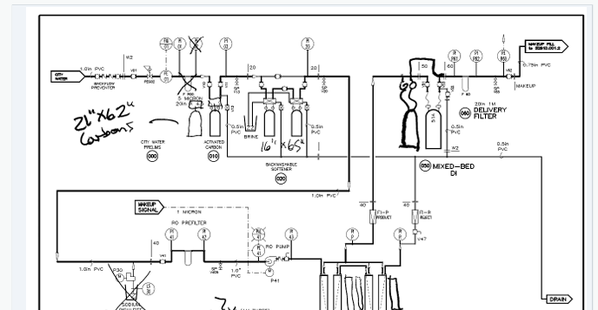
Design Input: Customer P&ID markups specifying equipment sizing and process changes, including removal of the sodium bisulfite anti-scaling loop.
Structure: C4 x 5.4 structural channel base, TS1.5 x 1.5 x 0.125 square tubing superstructure, and 1/4" mounting plates for equipment tie-downs.
Piping: Schedule 80 thermoplastic piping in Polypropylene (PP) and PVC, selected over carbon steel for corrosion resistance and purity retention.
Key Equipment: Multistage pumps (CRNE 10-5 N-FGJ-A-E-HQQE), DI Dual Tank Systems (Ø14"x47", 3.6 CF each), 7R Duplex Filter (0.1 micron), and dual 254nm UV Sterilizers (Model 01CDS).
Spatial Optimization: Fitting five distinct treatment stages (DI tanks, multistage pumping, duplex filtration, UV sterilization, and analytical instrumentation) within a tightly constrained footprint while keeping ergonomic access for maintenance and filter replacement.
Vibration and Load Management: Ensuring the structural base could carry the static weight of water-filled tanks and the dynamic loads and vibration from the high-pressure multistage pump.
Material Compatibility: Selecting corrosion-resistant piping materials and schedules that handle required flow rates and pressures without leaching contaminants into the high-purity water stream.
The layout was modeled iteratively to follow the process fluid flow while keeping the center of gravity balanced.
Design Evolution: The customer's marked-up P&ID set the equipment sizing and process changes. These were translated into a production-ready 3D mechanical layout without expanding the skid footprint.
Structural Framework: The channel base uses C4 x 5.4 for rigidity and vibration dampening. The square tube superstructure supports the control panel, pipe routing, and overhead instrumentation. Anchor clips allow secure floor mounting.
Pumping Station: Multistage pumps sit at the front-center, aligned with the control valves, in a duty/standby configuration for redundancy.
Deionization Array: The DI Dual Tank Systems, which perform ion exchange polishing, are arranged linearly to maximize treatment capacity without widening the footprint.
Sub-Micron Filtration: The 7R Duplex Filter (0.1 micron) is elevated for easy cartridge replacement and includes flow indicator and recorder elements.
Sterilization: Dual UV sterilizers are mounted in parallel at the top of the superstructure for final biological control.
Piping & Connections: Schedule 80 PP/PVC piping with 150# flanged connections at critical junctions allows modular disassembly and component replacement, keeping the wetted path free of leachable contaminants.
Tie-In Connections: Facility tie-ins were standardized as follows: A1 makeup water inlet (1 1/2" SCH 80 PP), A2 city water supply (2" SCH 80 PP), and A3 drain line (1/2" SCH 80 PVC).