

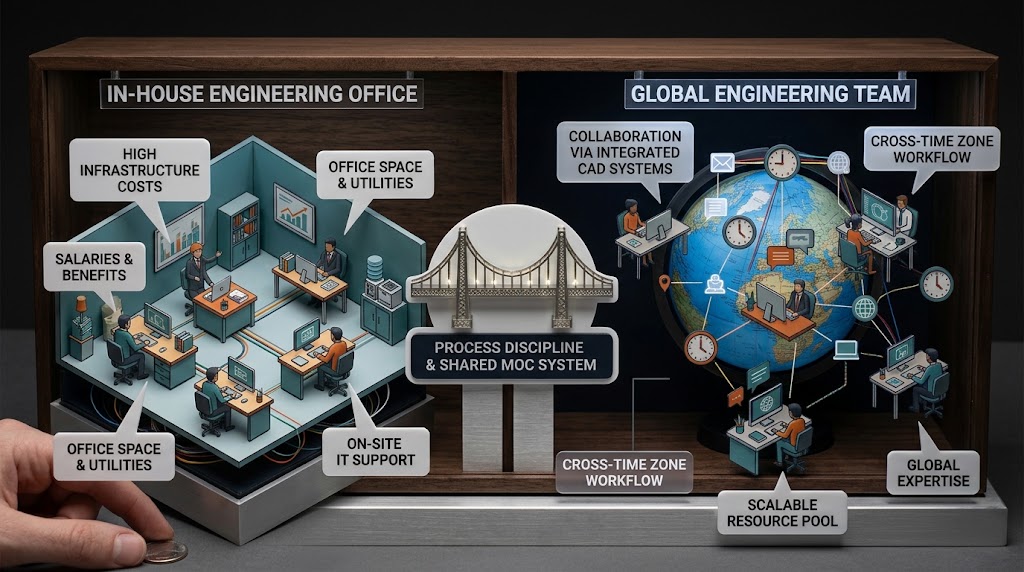
Every plant engineering team eventually asks the same question: build the design capability in-house, or bring in an outside team? It comes up during a hiring freeze, after a bad experience with a vendor, or simply when a project pipeline grows faster than the internal team can absorb.
The honest answer is that both models work, and both models fail, depending on how well the underlying process holds up. Geography gets the blame more often than it deserves; process discipline is usually the actual variable, and once you see it that way, the decision gets a lot easier to make.
In-house and offshore plant engineering teams both work, and both fail, for the same underlying reason, process discipline, not geography. In-house teams break on cost creep and thin bench depth (a single resignation can stall a project for months). Offshore teams break on misaligned scope, communication drag, and poor integration into a plant's MOC and document control systems.
The fix in both cases is the same: a scoped, reviewed, documented process, defined deliverables, review checkpoints, backup contacts, and a shared document-control system that works the same way whether the engineer sits down the hall or across a time zone.
Below is a breakdown of where each model actually breaks, what to ask a prospective offshore partner, and why hybrid in-house/offshore models have become the default for mid-size plants.
On this page ▾
01The Appeal of In-House Teams
There's a reason plants default to in-house engineering. When your piping engineer sits three desks away from your process lead, misalignments get caught in a hallway conversation instead of an email chain. Decisions happen fast. Nobody has to explain the plant's history, its quirks, or why a particular line was rerouted five years ago during a turnaround, because the person doing the work already lived through it.
There's also a control argument. In-house teams work under your NDAs, your IT systems, and your direct supervision. For plants dealing with proprietary processes or sensitive intellectual property, that direct control matters. You know exactly who has access to your P&IDs, your process data, and your equipment specifications, because they're your employees. This is usually the first concern that surfaces when confidentiality comes up at all: not whether an outside partner is competent, but whether your IP stays yours.
None of this is wrong. But it comes at a cost that grows quietly until it's suddenly very visible.
02Where In-House Breaks: Cost Creep
The first place in-house engineering runs into trouble is cost. Salary is the smallest part of the bill. Add benefits, payroll taxes, software licenses for CAD and simulation tools, training, equipment, and office overhead, and the real cost of a single senior engineer is often 40 to 60 percent higher than the number on their offer letter. None of that cost flexes with workload. A team sized for your busiest quarter is carrying dead weight the other three.
This becomes especially painful during project troughs. You either keep engineers on staff with nothing to design, which erodes margins, or you let them go and lose institutional knowledge you'll need again in six months. Neither option is good, and most plants end up doing some version of both over a long enough timeline, which is its own kind of expensive churn.
03The Appeal of Offshore Teams
Offshore engineering solves the cost and bench-depth problems almost by design. You get access to a larger pool of specialists, piping stress analysts, instrumentation engineers, automation specialists, whatever the project calls for, without carrying them on payroll between projects. Rates are typically lower, not because the work is lower quality, but because the cost of living and overhead in offshore engineering hubs is structurally different. And because offshore teams like us usually operate on a dedicated or pooled staffing model, losing one engineer doesn't halt a project the way it does with a three-person in-house team.
The requests that actually come through the door tend to be plain and specific: prepare fabrication drawings for a compressor skid, recreate an old drawing set for a slug catcher, convert a stack of legacy PDFs into working CAD files, or review and optimize the layout of a pressure vessel or heat exchanger. It's rarely an abstract question about "engineering services." It's a named piece of equipment and a deliverable.
There's also a genuine time zone advantage, if it's used correctly. Site changes or redlines sent at the end of your workday can be picked up immediately by an offshore team and turned around before your team is back at their desks the next morning. Used well, this isn't just a cost saver, it's a real compression of your project timeline.
04Where Offshore Breaks: Misaligned Expectations
The most common complaint about offshore engineering is scope. Plants that jump into an offshore relationship expecting instant results at a steep discount, without locking down deliverables, review checkpoints, and acceptance criteria upfront, are the ones who end up disappointed.
This is fixable, but it requires more upfront discipline than working with an in-house team, where shared context papers over a lot of ambiguity. Offshore relationships need that context written down: design basis, standards references, prior MOC history, and a review cycle that catches drift early rather than at final issue.
There's a related, more pointed version of this concern: whether an offshore team actually understands the codes and standards a plant runs on, not just the software. If a scope calls out ASME pressure vessel design or an API 650 tank, the team on the other end needs to already be fluent in those standards, not learning them on your project. This is worth confirming directly, with a sample deliverable or a technical walkthrough, before signing anything, rather than assuming it.
Where Offshore Breaks: Communication Drag
Even with a clear scope, communication can drag if there's no structure to it. Time zone differences that are an advantage for turnaround can become a liability when something urgent needs a same-hour answer and the right person is asleep. Email threads with no clear owner turn into multi-day loops. A question that would take thirty seconds to resolve in person takes two days to resolve across time zones without a defined escalation path.
The fix here isn't proximity, it's process: defined review cycles, clear points of contact, and asynchronous documentation that doesn't rely on someone being awake to answer a question. Tools like shared issue trackers and structured markup reviews solve most of this, but only if both sides actually use them consistently.
Where Offshore Breaks: Integration Friction
The last failure point is the one that shows up latest and matters most: integration friction. Offshore engineers who are treated as an external vendor, kept outside your standards library, your MOC process, and your document control system, end up producing work that technically meets spec but doesn't feel native to your plant. It's the equivalent of a contractor building to code but not to your house.
This is where a lot of offshore engagements plateau. The work is competent, but it never quite becomes an extension of the internal team, and that gap shows up in every subsequent revision, every redline, every as-built reconciliation.
05What "Fluent in the Codes" Actually Looks Like
It's easy to claim standards fluency in a sales call. It's harder to back it up with a real track record, and this is where the "can an offshore team actually deliver" question gets easiest to put to rest.
At Acufore, that track record isn't a slide of logos, it's over 100 process skids taken from layout to fabrication drawing across Oil & Gas, Petrochemical, Chemical Processing, Water Treatment, and Food & Beverage, more than 15,000 engineering hours in, covering everything from suction scrubbers and three-phase separators to compressor skids, vapor recovery units, and PIG launcher/receiver skids. On pressure vessels, it's another 100-plus ASME vessels and shell-and-tube exchangers, running mechanical design calculations, nozzle reinforcement analysis, and saddle and skirt support design across ASME Section VIII Div 1 and 2. And on storage tanks, it's north of 450 shop- and field-fabricated tanks to API 650 and ULC-S601, from 300-gallon shop units to field-erected tanks holding three-quarters of a million gallons.
That volume shows up in how routinely the tools get used, not just whether they're on a resume. CAESAR II for pipe stress, PV Elite and COMPRESS for vessel calculations, STAAD Pro and ANSYS for structural and lifting analysis, these aren't tools our engineers are learning on your project. They're the tools your project walks into on day one. That's the difference between an outsourced partner you're hoping will work out and one with a track record you can actually verify before you sign anything.
06What Actually Decides the Outcome
Look back at the three offshore failure points above and a pattern shows up: each one gets fixed by a structured process wrapped around the relationship, not by closing the distance. An offshore team plugged directly into your MOC process, working from the same document control system, reviewed against the same checklist your in-house engineers use, doesn't produce work that reads as "offshore." It reads as engineering, full stop.
This is also why hybrid models have become the default for a lot of mid-size plants rather than a strict either-or choice. In-house staff retain ownership of process safety decisions, MOC approvals, and anything requiring direct plant knowledge, while an offshore or outsourced partner handles detailed design, drafting, stress analysis, and document updates at volume.
07What to Actually Ask a Prospective Partner
If you're evaluating an outside engineering partner, the hourly rate is the least useful number to anchor on. The questions that actually predict whether the relationship will work are more specific:
- What's the ratio of engineers to project managers on their end? A partner who's mostly PM layers between you and the actual designer adds a translation step that slows everything down and tends to be where scope gets lost in the retelling.
- Can they walk you through a mistake they caught on their own, before you ever saw it? Not a project that went wrong — a moment where their own QA process flagged something internally and fixed it before it reached your desk. That's a better signal of process maturity than a clean track record.
- How do they ramp up a new engineer on your plant's standards and history? Every partner loses or rotates people eventually. What matters is whether there's a documented onboarding process for a replacement, or whether institutional knowledge walks out the door with whoever leaves.
- What do they do when a drawing is technically correct but operationally wrong? This gets at whether they're just executing a spec literally or actually thinking about how the equipment will be operated and maintained — the gap this article calls out directly.
- Is their pricing based on hours, deliverables, or outcomes — and what happens when a deliverable takes longer than scoped? This surfaces how disputes get resolved before you're in one, rather than after.
A partner who answers these clearly, with specifics rather than general reassurances, is one who has actually run into these problems before and built a process around them. A partner who can only talk about cost savings hasn't.
TakeawayWhere Your Engineering Team Sits Isn't the Real Question
Where your engineering team sits will keep coming up in budget meetings, but it's rarely the thing that actually breaks a project. Scope it clearly, review it on a defined cycle, and track it inside a real document control system tied to your MOC process, and the distance between your desk and theirs stops mattering much. Skip any of that, and no amount of proximity or cost savings will save the schedule.
That standard, scoped, reviewed, and documented the same way whether the drawing is signed off in Houston or Bengaluru, is what Acufore has built its process around, which is why clients treat it less like a vendor and more like a plant engineering team that happens to sit in a different time zone.
Ashokan Kunhiraman is Founder & Director at Acufore. He holds an M.Tech in Mechanical Engineering (Machine Design) from IIT Madras, Chennai, and has 22+ years of experience in CAE, FEA, simulation and design calculations, including technology leadership roles at world-renowned organizations.
Acufore delivers plant and process engineering to clients worldwide: 1,400+ industrial projects and 100% client retention. This guide reflects standards and practices applied on live projects and is general information, not a substitute for project-specific engineering or legal advice.